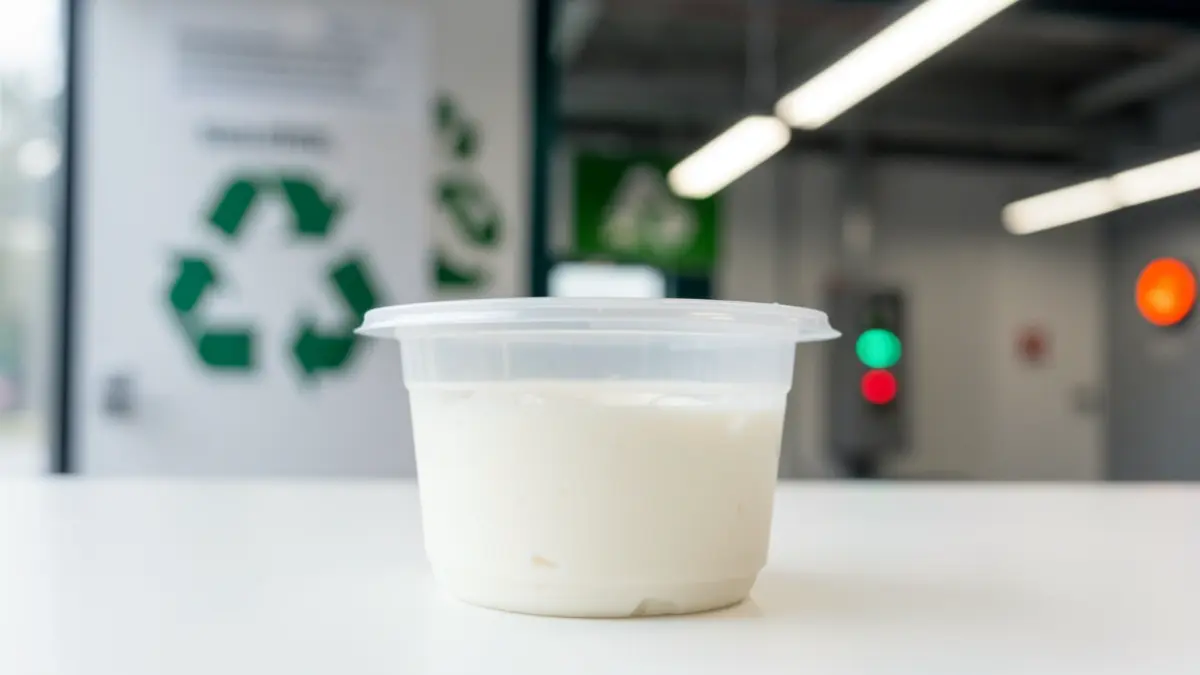
Back to the yogurt cup. You rinse it and throw it in the plastic waste. On 23 November, the plastic is mostly turned into park benches, rubbish bags or pallets, not new food cups. In addition, the UN Environment Programme estimates that around 85 percent of plastic used for packaging ends up in landfills or as litter. The figure applies worldwide.
– It is not the plastic that is the problem, but several factors prevent it from being recycled into food packaging. Current sorting facilities in the EU cannot effectively separate plastic packaging that has been in contact with food from other plastic packaging. Labels, glue and multiple layers in the packaging make sorting more difficult. The plastic must also be cleaned so well that it is as safe as virgin plastic, points out Nofima researcher Nusrat Sharmin. She has led the study.
Washing is an important part of this. Most European recycling plants wash Polypropylene (PP) gently, without soap and strong chemicals. Gentle washing can leave food residues in the material stream. This makes the recycled plastic unsuitable for contact with food, unless it undergoes sufficient cleaning and meets the requirements in the regulations. Odour often receives little attention. A study of plastic bottles showed that detergent removed 20–30 percent more odour from polyolefins than lye. The choice of detergent was more significant than the temperature. The solvent ethyl acetate removed 81–83 percent of the odour in PP bottles.
Both Polyethylene (PE) and Polypropylene (PP) are common in food packaging. They are lightweight, resist fat and protect well against moisture. We have mapped the packaging in Norwegian grocery stores. Of 580 food items, 261 had at least one packaging part made of PP. Cups, boxes and bowls were most common, followed by lids. Dairy products accounted for 32 percent of the cups and boxes. Ready meals accounted for 14 percent and spreads for 11 percent. The volume is large enough that recycling matters, says Sharmin.
Cups and lids are often made of the same plastic type, usually PP. Sorting becomes easier when the packaging consists of few plastic types. Packaging with multiple layers, glue, printing and different plastic types is difficult to sort. Therefore, both the choice of plastic and the design have a lot to do with recycling. Packaging made of one plastic type can be of the same quality as multi-layer packaging for several food items. But it does not fit everything, so manufacturers must test it for each individual product, explains senior researcher Marit Kvalvåg Pettersen at Nofima. She leads the Green Platform project Re3-Plast, in which the study was carried out.
The regulations and tools are closely linked. The EU requires that all packaging must be recyclable from 2030. The industry tool RecyClass provides guidelines for design for recycling and evaluation protocols that help manufacturers assess how well their packaging fits into existing collection, sorting and recycling systems. The tool uses a traffic light system that shows how well the packaging is suitable for recycling. Green means it is well suited, orange means it is partially suitable, and red means it is poorly suited.
Recycled plastic that is to be used in contact with food must meet strict requirements. The EU requires that the plastic comes from an approved process. The process must remove pollutants, and the entire chain must be traceable. The plastic must be as safe as virgin plastic. Current regulations prohibit bisphenol A (BPA) in materials that come into contact with food, and the limit values for PFAS, so-called forever chemicals, were tightened from August 2026.